Sit through three FinOps platform demos this quarter and you will hear the same promise three times: we have an AI agent. Two of them turn out to be a chat box sitting on top of a dashboard, answering from a copy of your data. The third is wired into the platform itself and shows up in the tools your team already uses. They all used the word “agent,” and only one of them meant it.
That is the problem with agentic FinOps as a category. The label has spread faster than the capability behind it, so it no longer tells a buyer much on its own. The good news is that the difference between a real agent and a bolted-on chatbot is not subtle once you know what to look for. This piece lays out the test, and shows how FinOpsly’s own assistant, Ask FI, measures up against it.
What “agentic” should actually mean in FinOps
An agentic FinOps tool does more than report cost. It takes a question in ordinary language and answers it from your own governed data, and in its fuller form it can act on its own within the rules you set. The word “agent” has a specific meaning here. An agent is driven by a language model, but it is given a set of tools and it decides which ones to use for the job in front of it. Ask a harder question and it breaks the request into smaller steps, works out what it needs to look up, calls the right tools across different parts of the platform, checks whether it has enough to answer, and only then replies. That is the difference from a search box that runs one query and stops.
It also helps to separate two words that often get used as if they mean the same thing. A copilot answers when you ask it something. An agent can also reach out on its own, for instance by flagging a problem before anyone goes looking for it.
Underneath the jargon, the shift is about where the answer lives. For years, finding out why cost moved meant opening a monthly dashboard and digging. What teams want now is the answer where they already are: in a chat, in a channel, in the code editor. A tool earns the word “agentic” by closing that distance, not by adding a search box.
Four questions that separate a built-in agent from a bolt-on
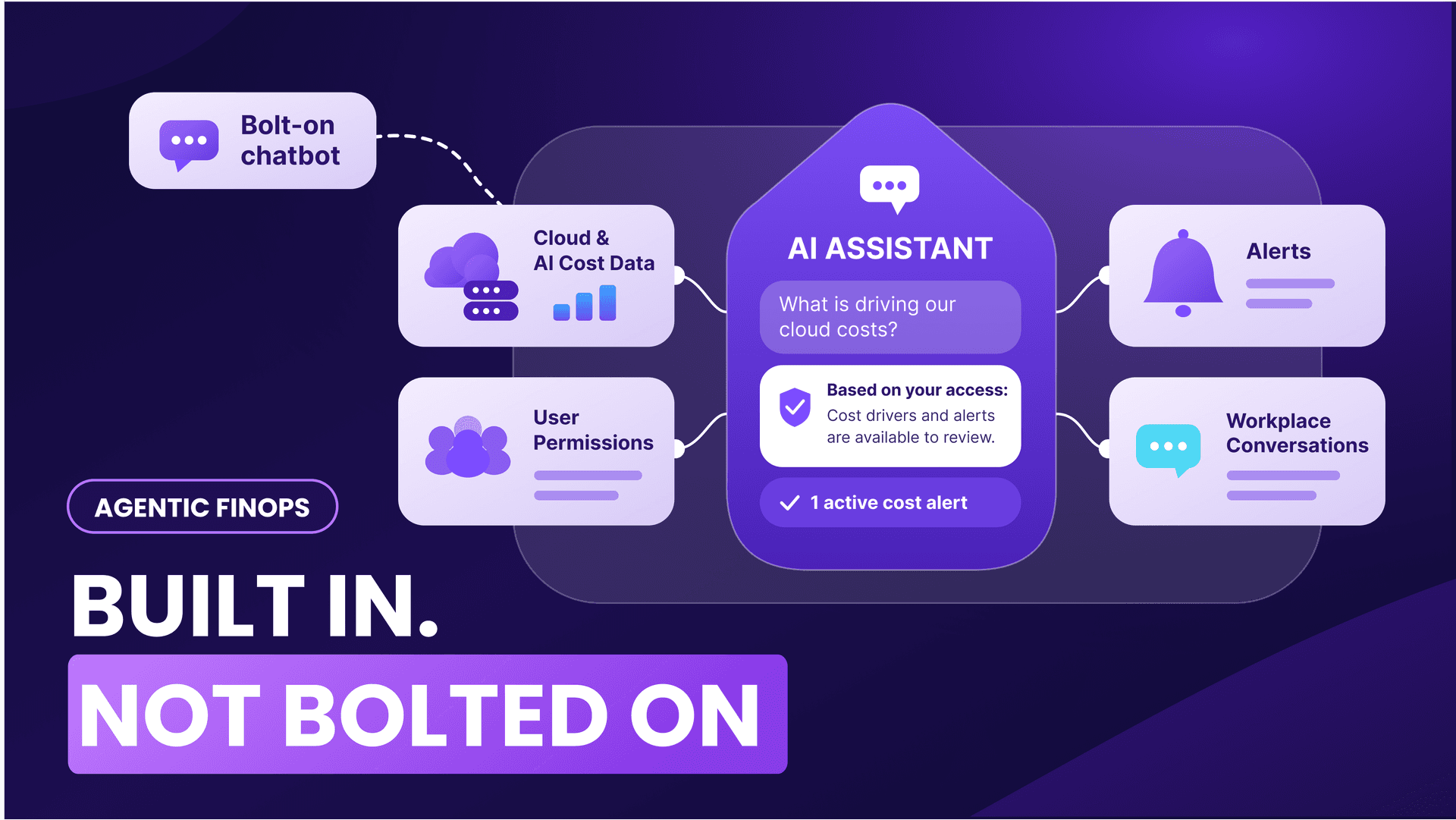
When a vendor claims an agent, four questions will tell you how much is real. Was it built into the platform, or added on after the fact? Does it read the same governed, attributed data the rest of the platform runs on, or a separate copy that can fall out of date? Does it respect permissions, so finance, engineering, and the business each see only what they are allowed to? And does it reach people in the tools they already use, rather than asking them to log into one more place?
Ask FI, FinOpsly’s built-in assistant, was designed to answer all four with a yes. FinOpsly is an AI cost governance platform that unifies cloud, data, AI, and SaaS spend under one cost model, and Ask FI is the way people talk to it. It lives where the work happens: inside the platform, in Microsoft Teams, and in development environments such as GitHub, Copilot, and VS Code through an MCP server. An engineer can ask “What changed?” or “Why did this cost go up?” right there in the editor and trace the root cause without ever opening a billing tool. The answers cover cost and usage, budgets, tags, recommendations, and realized savings, in plain language, and each one stays inside the asker’s permissions. A finance analyst and an engineer can ask the same question and get answers scoped to what each is allowed to see.
A real agent does not wait to be asked
This is where the chatbot comparison breaks down for good. A built-in assistant can start the conversation itself. When Radar, FinOpsly’s anomaly detection, catches a cost spike or an unexpected dip, FI can post a notification straight into a Teams chat or channel, with the alert style tuned per business unit, and the team can ask follow-up questions right there in the thread. The thing that noticed the problem and the thing that answers your questions about it are in the same place you already talk.
It is worth being precise about the boundary, so this does not read as more than it is. Ask FI reads data, answers questions, and surfaces alerts. It does not stop a resource or make other governed changes on its own; that sits in a separate part of the platform, behind approvals. That is the honest shape of agentic FinOps today, proactive and conversational, and always inside each person’s permissions.
Look past the word
“Agent” is on nearly every FinOps website now, which means it has quietly stopped meaning anything by itself. What you can still check is whether the agent is part of the platform, reads your real data, respects who is asking, and meets people where they work. Run any tool through those four questions and the marketing takes care of itself.
If you are evaluating the top agentic FinOps solutions right now, that short test will save you a lot of demo time.
See Ask FI in your workflow
Ask a cost question in plain language, in the platform, in Teams, or in your IDE, and get an answer scoped to your access.
Frequently asked questions
Which FinOps platforms have an AI agent built in?
When you shortlist a FinOps platform with AI agent built in, look for an assistant that is native to the platform, reads the platform’s own governed data, respects user permissions, and works inside the tools teams already use. FinOpsly’s Ask FI is built this way, in the platform, in Microsoft Teams, and in the IDE through MCP.
What is the difference between a FinOps copilot and an agentic FinOps platform?
A copilot answers questions when asked. An agentic platform can also act on its own within policy, for example sending an alert when spend moves, instead of only replying to a prompt.
What makes an AI agent “built in” rather than bolted on?
A built-in agent reads the same governed, attributed data the platform already uses and respects its permissions. A bolted-on chatbot usually sits on top and works from a separate copy of the data.
Where does a FinOps copilot live day to day?
In the places people already work. Ask FI is available in the platform, in Microsoft Teams, and in development tools such as GitHub, Copilot, and VS Code through an MCP server.
Learn how FinOpsly governs AI spend with AI cost governance.