Costix: Bringing Cost Certainty to Cloud, Data, and AI Planning
Most cost problems in cloud environments do not begin in production.
They begin much earlier, during planning, solution design, and budgeting, when teams are forced to make high-impact decisions with incomplete or unreliable cost information. By the time costs show up in billing reports, architectures are already deployed, contracts are signed, and budgets are committed.
Costix was built to close this gap.
Sitting at the intersection of planning, solutioning, and budgeting, Costix helps teams design architecture-aware solutions and generate accurate cost estimates before anything is built, regardless of the underlying technology stack.
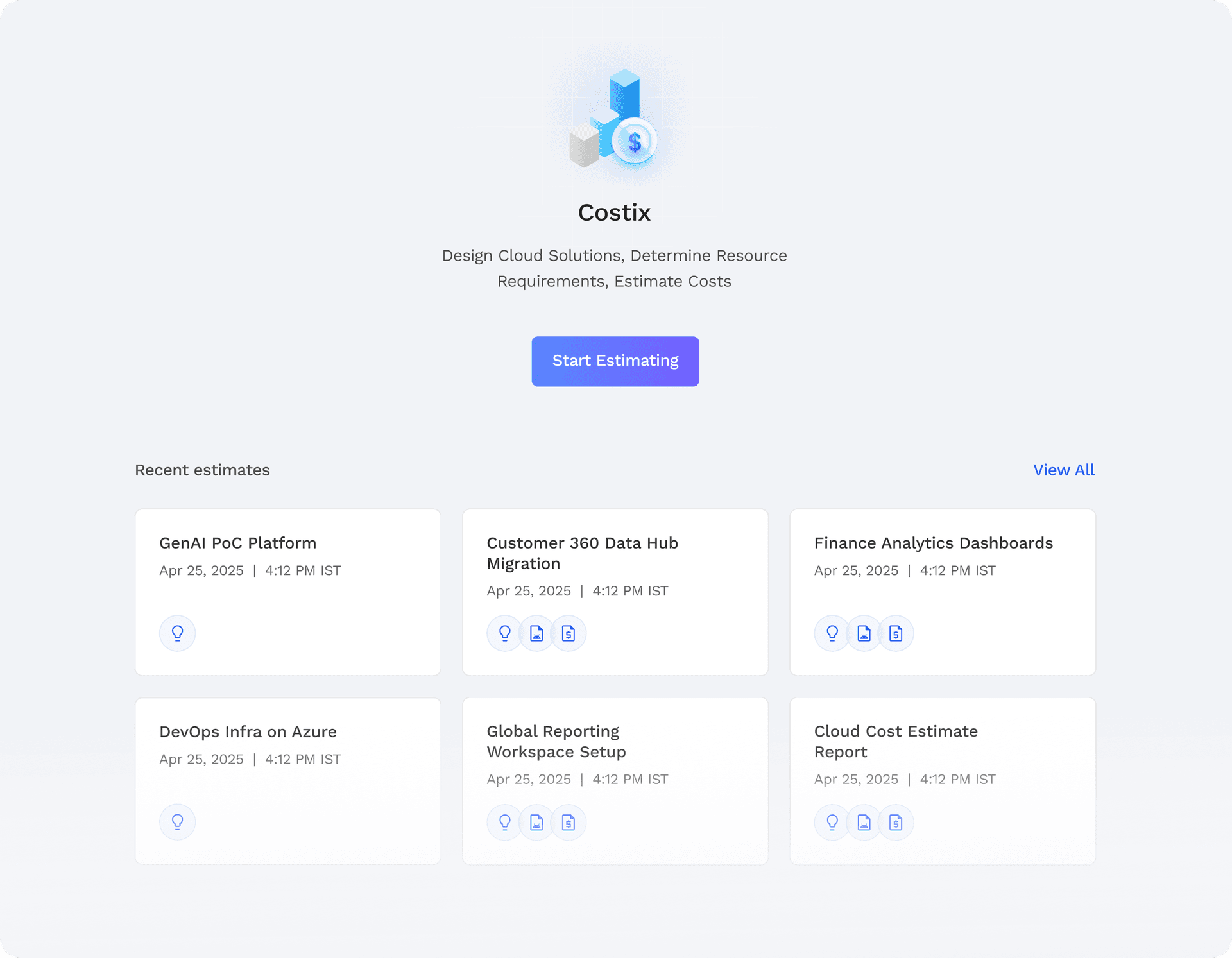
Why Cost Estimation Breaks Down Today
Even in mature organizations, pre-deployment cost estimation remains one of the weakest parts of the FinOps lifecycle.
Common challenges include:
- Fragmented calculators across infrastructure, data platforms, ETL tools, analytics services, and DevOps tooling
- Estimates built on generic on-demand pricing that is disconnected from enterprise-negotiated rates and commitments
- Architecture blind spots, where costs are estimated without fully accounting for real design patterns, guardrails, and operational assumptions
- Heavy reliance on scarce solution architects, whose time is consumed by repetitive estimation and modeling work
The result is familiar. Estimates take weeks to produce and still diverge materially once workloads go live.
Where Costix Fits in the Lifecycle
Costix operates upstream of traditional FinOps tooling.
It is designed for moments when decisions are still flexible:
- Planning a cloud migration
- Designing a new application or platform
- Modernizing data and analytics stacks
- Evaluating new AI or automation initiatives
By embedding cost intelligence directly into solution design, Costix helps teams prevent overruns instead of reacting to them.
Architecture-Aware Solution Design
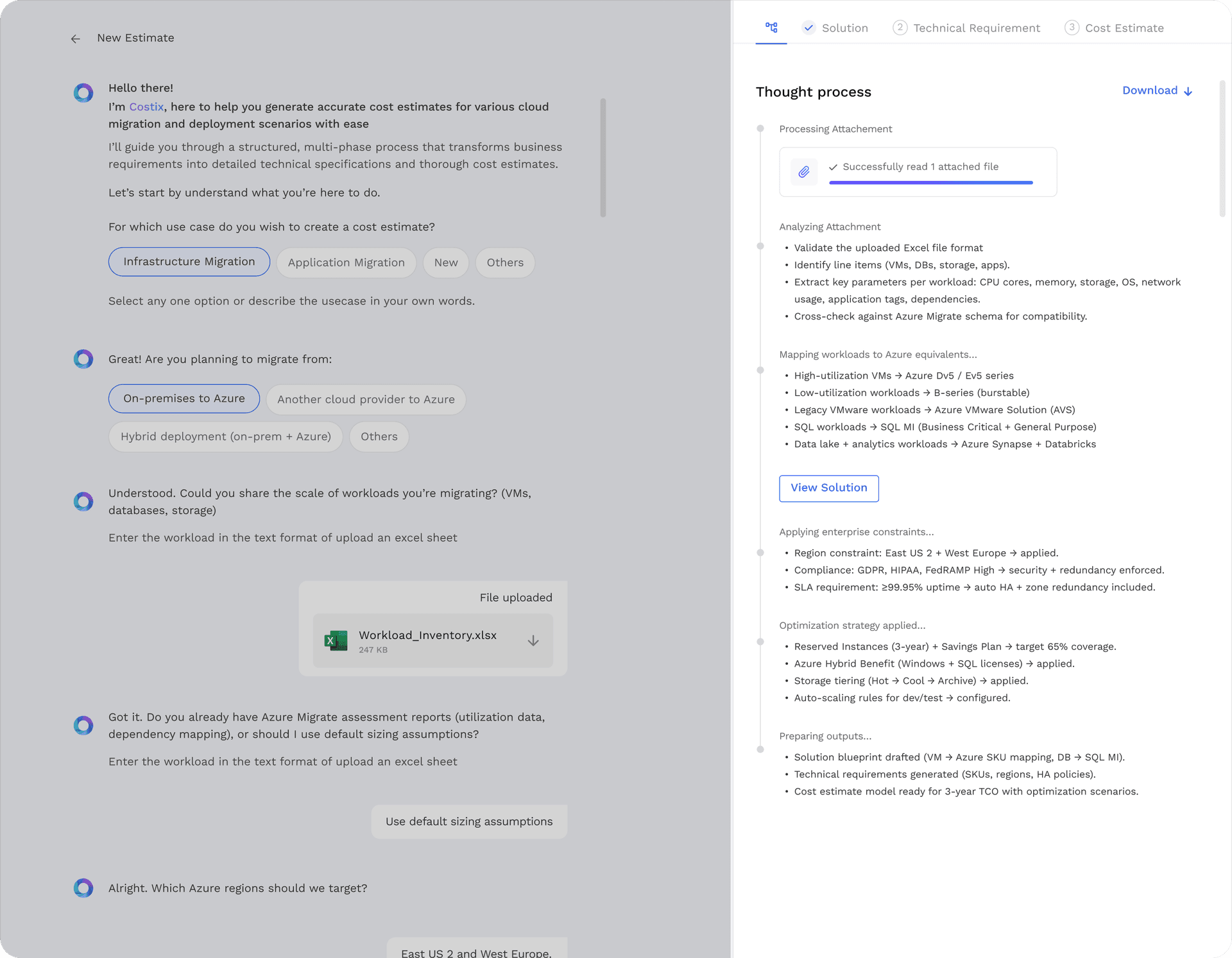
At its core, Costix treats cost estimation as a solution design problem, not a pricing exercise.
Instead of forcing users to assemble SKUs or jump between calculators, Costix:
- Guides users through functional and non-functional requirements
- Applies company-defined architecture patterns and guardrails
- Builds a complete, architecture-aware solution blueprint
In practice, Costix behaves much like a digital solution architect, standardizing design assumptions while dramatically reducing manual effort.
Example:
A team designing a new application defines expected users, data flows, environments, reliability needs, and growth assumptions. Costix translates those inputs into a structured solution blueprint covering compute, storage, networking, data movement, pipelines, and supporting services. The blueprint is aligned to the organization’s approved stack and design standards.
Estimates Built on Real Enterprise Pricing
One of the most common sources of estimation error is pricing mismatch.
Costix estimates are built using:
- Customer-specific negotiated pricing
- Existing commitments and discounts
- Approved regions, services, and deployment models
This ensures estimates reflect how the organization actually consumes technology, not simplified public pricing models that rarely apply in practice.
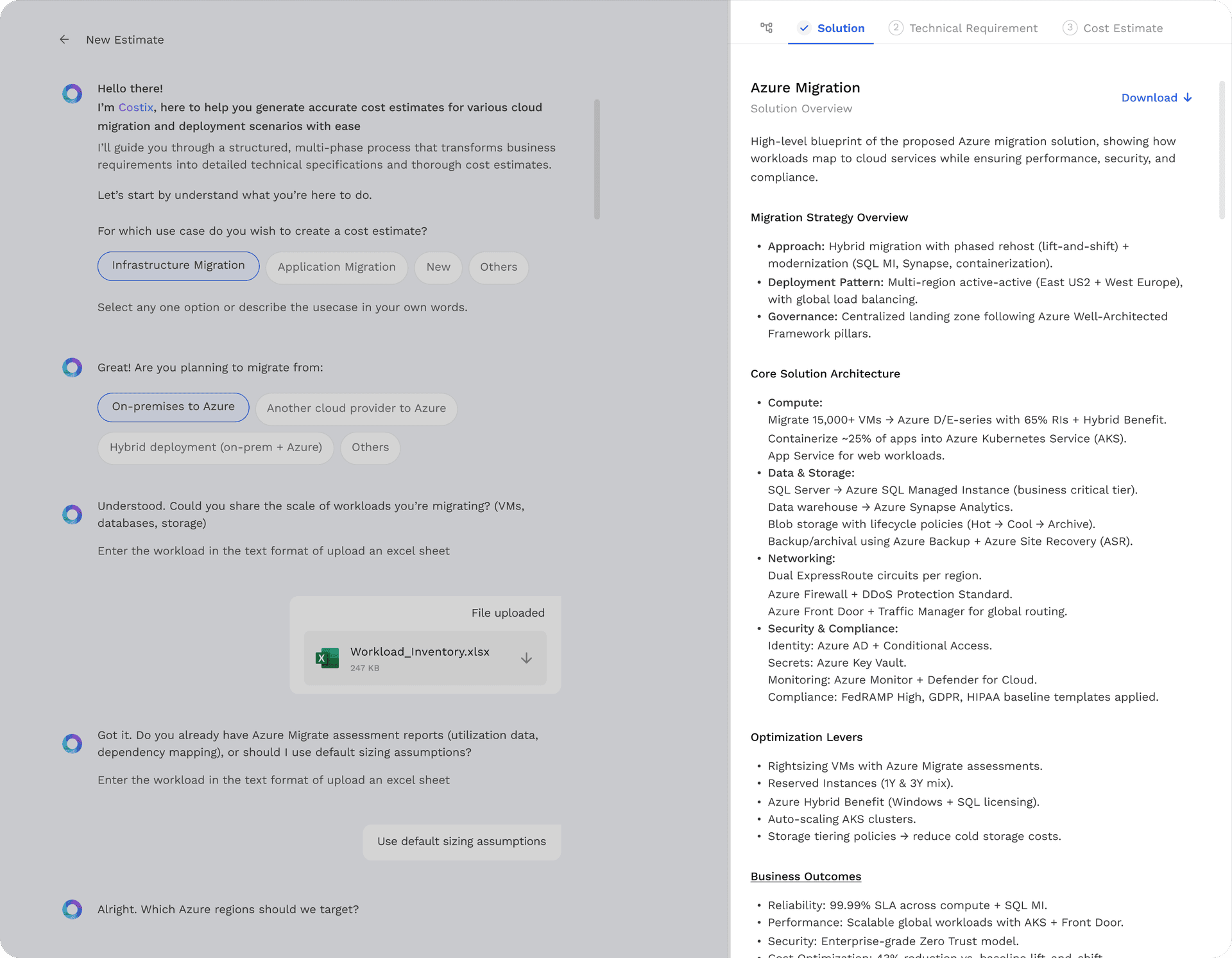
A Single Planning Layer Across the Technology Stack
Modern solutions rarely rely on a single platform.
Costix is intentionally technology agnostic. It can model solutions across any stack defined by the organization, including:
- Cloud infrastructure and platform services
- Data platforms, warehouses, and lakes
- ETL and data integration tools
- DevOps and CI/CD tooling
- Analytics, AI, and downstream consumption layers
Rather than producing isolated estimates per tool, Costix generates a unified view of the entire solution. This includes how components interact, how they scale, and how cost accumulates across layers.
Defining Workloads Clearly Across Environments
Costix structures estimates around real operational environments:
- Development
- Test
- Production
For each environment, it defines:
- Workload characteristics and scale assumptions
- Usage patterns and growth drivers
- Cost sensitivity to design choices
This clarity creates a shared language between solution architects, engineering teams, and finance, reducing rework and misalignment later.
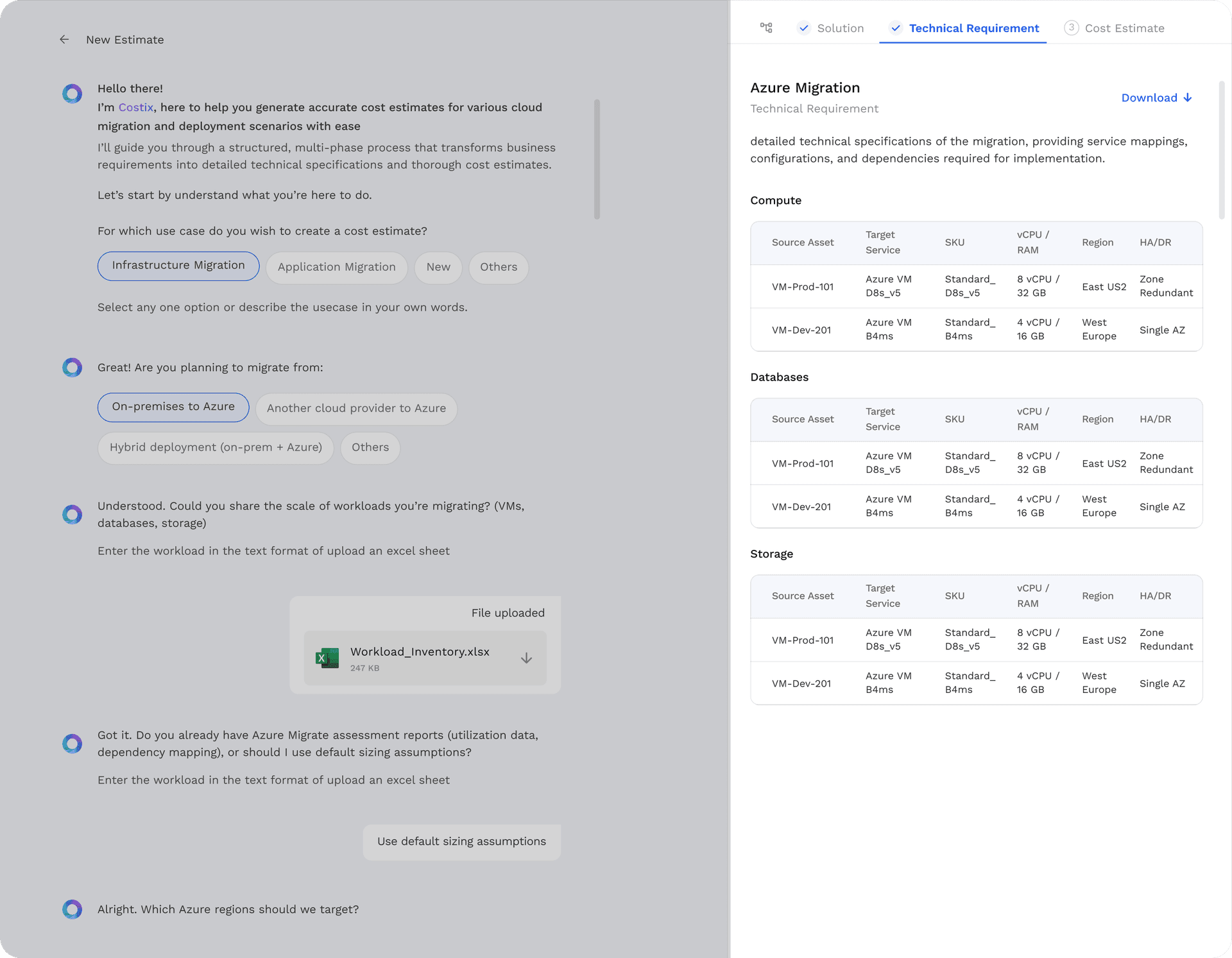
Scenario Modeling and Design Tradeoffs
The most valuable cost decisions are made while designs are still negotiable.
Costix enables teams to:
- Compare alternative architectures and tooling choices
- Understand cost implications of scale, resilience, and performance requirements
- Explore tradeoffs before committing to a final design
Because this happens early, teams can optimize for both cost and capability without compromising delivery timelines.
Enabling Better Budgeting and Business Cases
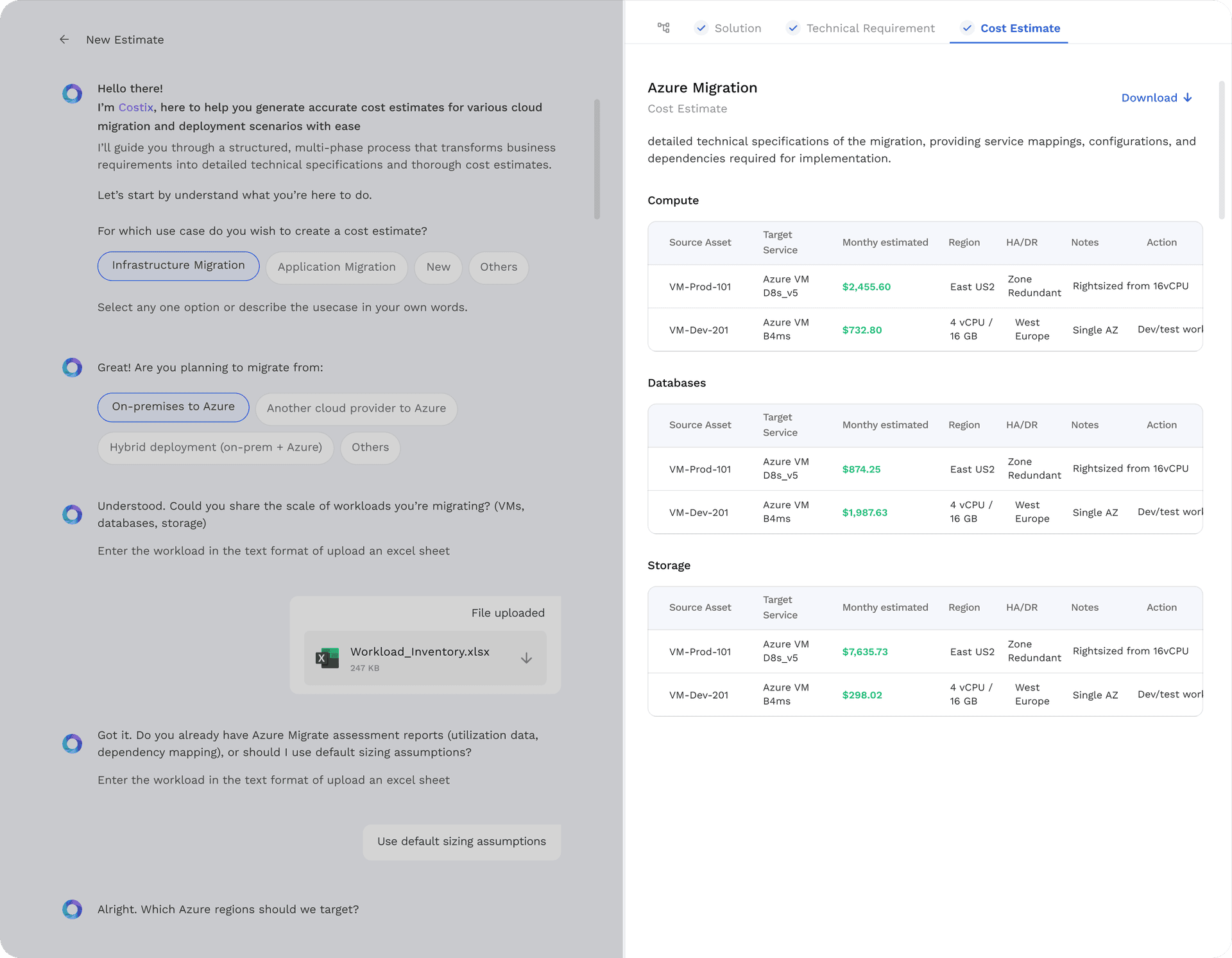
Because Costix outputs are architecture-aware and pricing-accurate, they translate naturally into financial planning.
Teams use Costix to:
- Build defensible business cases
- Improve forecast accuracy
- Reduce variance between planned and actual spend
Finance teams gain earlier visibility, while engineering teams retain control over design decisions.
How Costix Fits Within FinOpsly
Costix serves as the planning and solution design foundation within FinOpsly’s broader FinOps lifecycle.
By anchoring cost decisions upfront, it reduces the downstream effort required for optimization, automation, and governance, making the entire FinOps process more predictable and effective.
Closing Thoughts
Cost optimization is most effective when it starts before anything is deployed.
By combining architecture-aware solution design, real enterprise pricing, and unified planning across diverse technology stacks, Costix helps organizations move from rough guesses to confident plans.
In an environment where technology decisions move fast and budgets are under constant scrutiny, cost certainty at design time is no longer optional. It is foundational.
Learn how FinOpsly governs AI spend with AI cost governance.