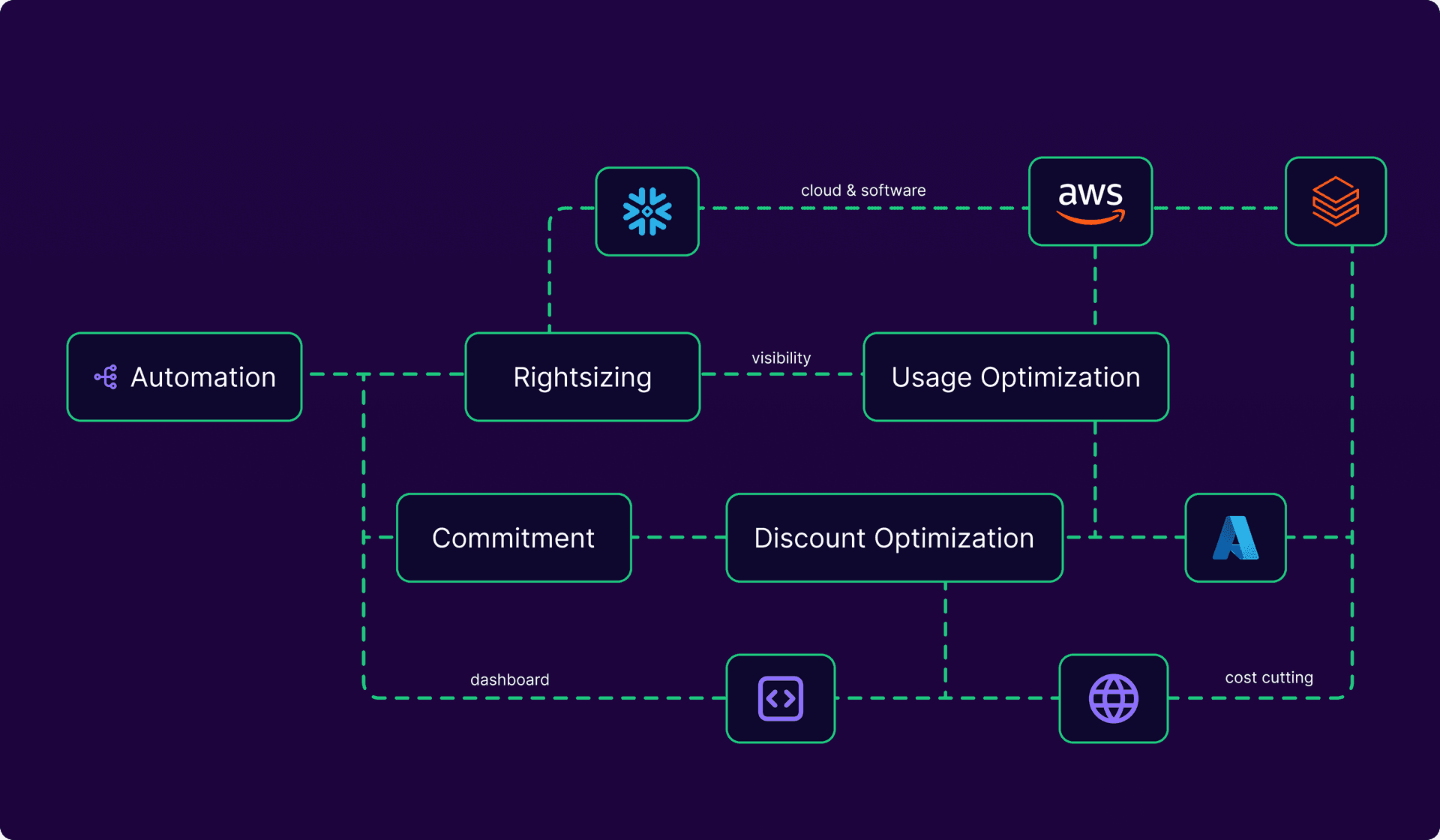
Automating FinOps: From Cost Insights to Continuous Control
For years, FinOps has focused on visibility, dashboards, reports, and alerts designed to help teams understand where cloud and data spend is going. While this visibility is necessary, it has proven insufficient on its own.
As cloud, data, and AI environments scale across AWS, Azure, GCP, Snowflake, and Databricks, cost optimization is no longer a periodic exercise. It is becoming a continuous operational discipline. Automation is at the center of this shift.
This article explores what FinOps automation really means, where it delivers value today, and how organizations can approach it responsibly without losing control.
Why Manual FinOps Doesn’t Scale
Most FinOps teams still rely on a largely manual loop:
- Detect cost issues after they occur
- Analyze usage, tags, and metrics across tools
- Coordinate remediation with engineering teams
- Track savings separately, often in spreadsheets
This process breaks down as environments grow. The reasons are structural:
- The speed of spend exceeds human response time
A misconfigured Snowflake warehouse or Databricks job can generate thousands of dollars in cost within hours. - Optimization opportunities are repetitive
Many recommendations idle resources, oversized instances, unused commitments reappear every month. - Coordination overhead slows action
Even when insights are clear, getting the right teams aligned takes time.
Automation addresses these challenges by reducing latency between insight and action.
What “Automating FinOps” Actually Means
FinOps automation is often misunderstood as “auto-shutdowns” or aggressive cost-cutting. In practice, it is more nuanced.
Effective automation focuses on decision execution, not blind enforcement.
It typically includes:
- Translating cost insights into recommended actions
- Applying business and technical guardrails
- Executing changes safely or routing them for approval
- Measuring impact and learning from outcomes
Automation does not replace judgment; it augments it.
Practical Areas Where Automation Works Today
1. Rightsizing and Usage Optimization
Rightsizing recommendations are one of the most common FinOps outputs, and one of the least consistently acted upon.
Automation helps by: - Continuously re-evaluating usage patterns - Applying changes during safe maintenance windows - Reverting changes if performance degrades
Example:
An AWS EC2 fleet shows sustained low utilization. Instead of applying changes directly, automation can generate a rightsizing recommendation, package the required infrastructure-as-code changes, and route them through an existing change management or CI/CD process. This preserves engineering control while removing the manual analysis and coordination overhead.
2. Commitment and Discount Optimization
Managing Savings Plans and Reserved Instances is complex and time-sensitive.
Automation can: - Track coverage gaps continuously - Model different commitment scenarios - Execute purchases based on predefined risk thresholds
Example:
As Azure VM usage stabilizes for a production workload, automation can flag eligibility for commitments and simulate savings before purchase.
3. Anomaly Response, Not Just Detection
Detecting anomalies is only the first step. The real value lies in responding quickly.
Automation enables: - Immediate investigation of cost spikes - Correlation with deployments or configuration changes - Predefined containment actions when thresholds are breached
Example:
A Databricks job runs far longer than expected after a code change. Automation can pause non-critical jobs and notify owners while analysis is underway.
4. Data Platform Cost Controls
Usage-based pricing makes platforms like Snowflake and Databricks ideal candidates for automation.
Automation can manage: - Warehouse auto-suspend policies - Job scheduling and concurrency limits - Cost attribution by workload or team
These controls prevent small inefficiencies from compounding into material overruns.
Automation Rails: Choosing the Right Path to Action
Not every optimization should be executed the same way. Mature FinOps automation relies on multiple execution paths, or automation rails—based on risk, workload criticality, and operational maturity.
Common automation rails include:
- Workflow-driven automation: Initiating optimization actions through ITSM or change management systems, often paired with infrastructure-as-code, to align with existing operational controls.
- Human-in-the-loop automation: Using a copilot-style experience to gather additional context from engineers or workload owners before executing changes.
- Policy-based autonomous automation: Safely executing low-risk, non-disruptive actions automatically within predefined guardrails.
Selecting the right rail ensures automation accelerates action without bypassing governance.
The Guardrails That Make Automation Work
Automation succeeds only when trust is built into the system.
Effective FinOps automation includes:
- Explainability: clear reasoning behind every action
- Policy-based controls: different rules for dev, test, and production
- Human-in-the-loop options: approvals for higher-risk actions
- Reversibility: the ability to roll back changes quickly
Without these guardrails, automation creates resistance rather than adoption.
Automation Across Cloud and Data Platforms
The future of FinOps automation is cross-platform by default.
- AWS / Azure / GCP: rightsizing, commitment optimization, idle resource handling
- Snowflake: warehouse sizing, suspend behavior, query-driven cost controls
- Databricks: job orchestration efficiency, cluster utilization, workload isolation
Automating these in isolation limits impact. Coordinated automation enables consistent financial control.
How FinOpsly Approaches FinOps Automation
FinOpsly is designed around multiple automation rails, allowing teams to apply the right level of control for each situation.
- ITSM-integrated workflows can initiate automation using approved infrastructure-as-code paths
- Copilot-driven interactions gather workload context before actions are taken
- Policy-based automation safely executes low-risk, reversible optimizations
This model supports automation at scale without forcing a one-size-fits-all approach.
FinOpsly treats automation as a progression, not a switch.
- Recommendations are always explainable
- Actions can be routed through workflows or executed automatically based on policy
- Automation spans cloud infrastructure and data platforms
- Impact is tracked continuously to close the loop
This approach allows teams to start conservatively and expand automation as confidence grows.
Closing Thoughts
The future of FinOps is not more dashboards it is faster, safer execution.
Automation enables FinOps teams to: - Respond to cost signals in near real time - Eliminate repetitive manual work - Enforce financial guardrails consistently - Focus on higher-value decision-making
As cloud, data, and AI workloads continue to accelerate, FinOps automation will shift from optional to essential. The organizations that adopt it thoughtfully will be best positioned to maintain control without slowing innovation